Prepared wrapper material
Ready for sizing and rolling, matching the agreed samples.

ARAKA ADVANCED SYSTEMS / PAEIRO
THE NEXT MOVEMENTA NEW CHAPTER FOR YOUR PRODUCTION
More capacity for your Paeiro, with less dependence on manual assembly. A tailored production system starts with your product.
ENTER THE MECHANISM10 gestures. Every detail.CASE STUDY / REFERENCE CAPACITY
A tube-making case study, with a small operating crew. A price commitment for that capacity, against the agreed product, quality and working schedule.
02 / YOUR FACTORY’S NEXT CHAPTER
More capacity to serve orders. Less dependence on repetitive manual assembly. The same attention to the details that define your Paeiro.
From the magazine to the wipe after the blue cap. Every gesture has a place in the design.
See the details in motion ↓Thirty partners initially declined the project. A new ARAKA design changed the assessment and opened a route to prototyping.
ARAKA’s account of its partner discussions. The physical machine remains to be built and tested.03 / EVERY GESTURE, A MECHANISM
03 — 09Magazine to finishing. Malu’s narration and the mechanism move together. Pause to inspect.
Movement is slowed down to reveal each detail. A digital mechanism study; the physical prototype remains to be built.
Preparing the mechanism…
Drag to orbit · scroll to zoomINSPECTION POINT
DURING PROTOTYPING
Private notes in this browser; nothing is sent.
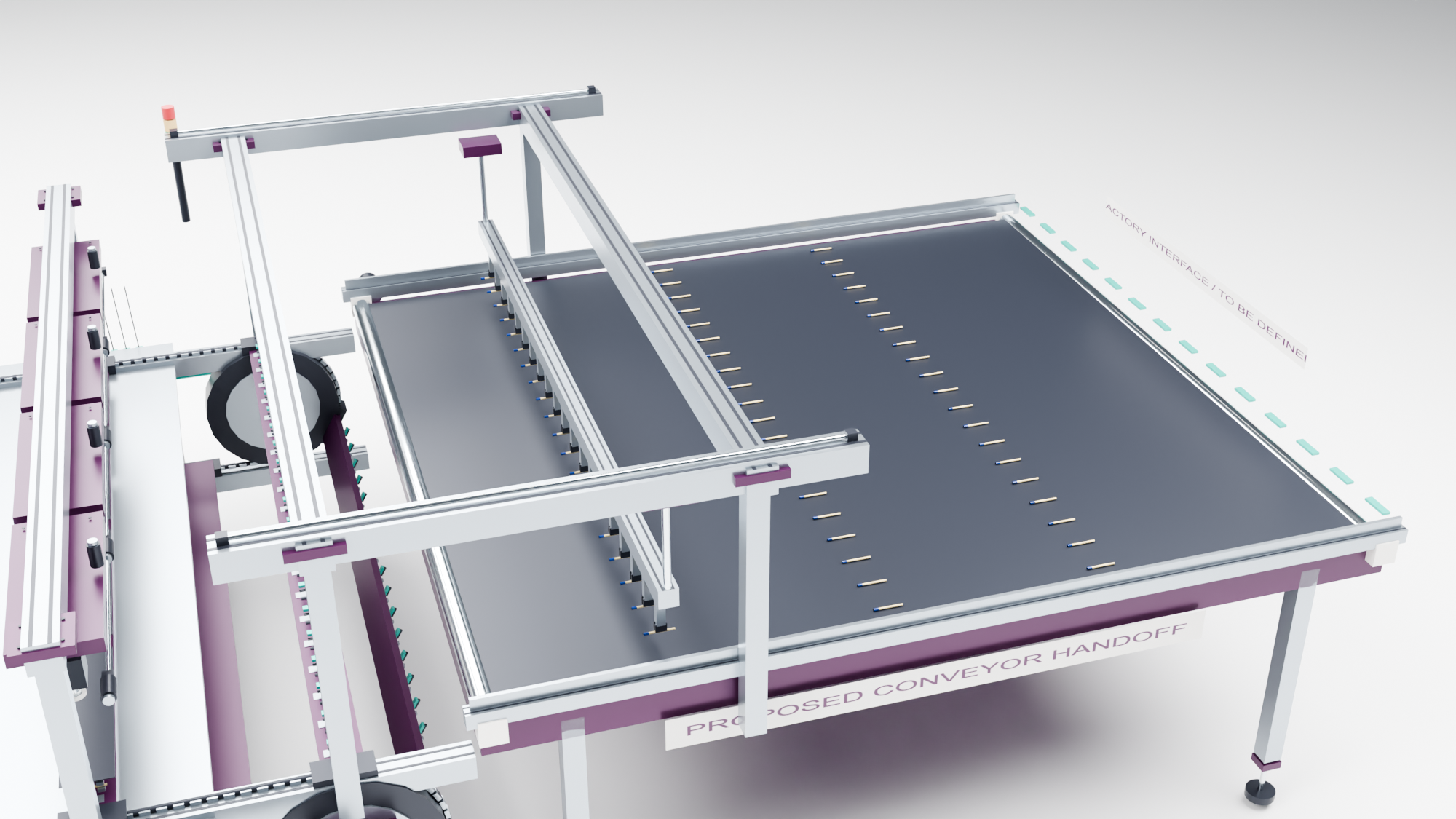
From the finished tube to your next station.
Proposed outfeed conveyor → existing tobacco shaker. Interface to be defined with your factory.See the 300-person capacity price ↓Digital mechanism study. Physical validation follows in prototyping. Magazine feed appears in 3D; the next nine actions accompany the manual footage.
Edit the text below to prepare the narration. Changes are saved only in this browser and do not alter the current recording. Export the text to prepare a new recording.
04 / THE PRODUCTION ARCHITECTURE
04 — 09Prepared material to finished empty tube. Coordinated mechanisms, with support and position considered at every step.
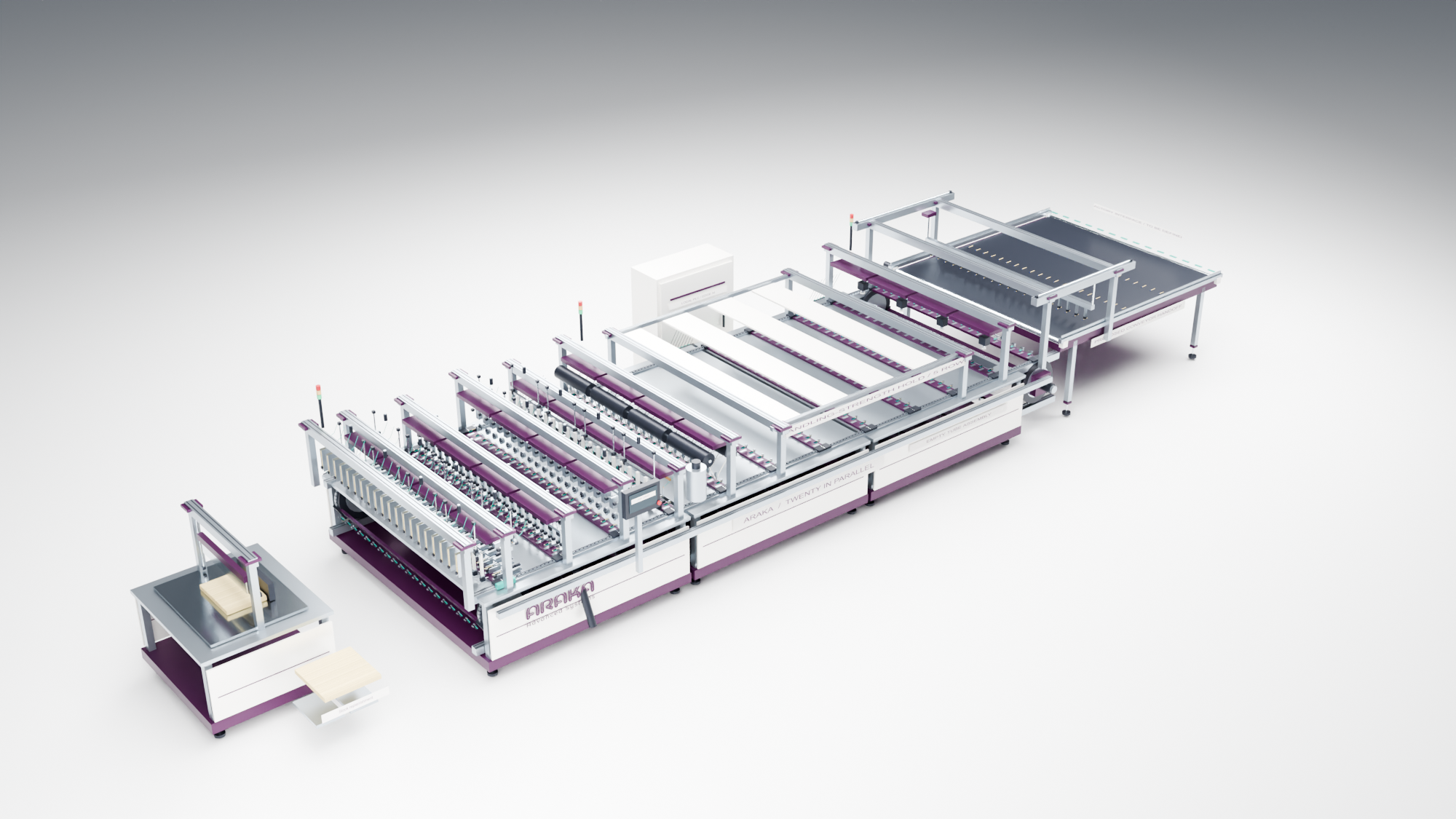
Ready for sizing and rolling, matching the agreed samples.
Proposed outfeed conveyor to the existing tobacco shaker. Interface and transfer to be defined with your factory.
THE INDUSTRIAL FOUNDATION
Feeding, cutting, winding, dispensing, seating and wiping already feature in other industrial lines. Our work is to adapt those principles to your product and connect the modules into one operation.
The Paeiro line is new. The industrial functions behind the design have commercial precedents.
Grippers for paper and foil separation, plus high-flow handling of porous materials.
Paeiro adaptationLeaf porosity, separation and marking still need sample trials.
Read the manufacturer’s reference ↗Automated textile cutting with vacuum hold-down.
Paeiro adaptationPaeiro needs its own blade, support geometry and edge-quality tests.
Read the manufacturer’s reference ↗Commercial convolute winding wraps sheets around a mandrel to form paper cores.
Paeiro adaptationThis example makes much larger, thicker cores. It supports the principle, not our leaf-forming design.
Read the manufacturer’s reference ↗Körber describes the Nano-T as commercial equipment for making paper filter tubes.
Paeiro adaptationPaper-based tube production is established; the Paeiro leaf, pre-curl sequence and filter interface need their own development.
Read the manufacturer’s reference ↗The ARB loads, stretches and applies elastic bands automatically.
Paeiro adaptationBand dimensions, supply and gentle placement on our small tube remain custom work.
Read the manufacturer’s reference ↗Industrial valves and automated dispensing systems control glue deposits and placement.
Paeiro adaptationAdhesive, dose, contact surfaces and cure behavior must be qualified for Paeiro.
Read the manufacturer’s reference ↗A published cap-feeding system sorts orientation and feeds correctly presented caps into an existing line.
Paeiro adaptationCap and filter geometry, singulation and feed paths must be engineered for our parts.
Read the manufacturer’s reference ↗ServoPress modules control travel and force for joining parts in automated lines.
Paeiro adaptationOur filter/cap tooling needs a suitable low-force range and compliant product support.
Read the manufacturer’s reference ↗DEK TQ has automatic understencil cleaning with a fabric roll; DEK fabrics collect residual solder paste.
Paeiro adaptationThis is an analogy for renewable wiping media. Removing wet glue from Paeiro requires separate contact and smear trials.
Read the manufacturer’s reference ↗Supporting reference ↗Machine vision checks whether caps are present and aligned.
Paeiro adaptationPaeiro needs its own lighting and acceptance rules; visible inspection does not prove internal bond or airflow.
Read the manufacturer’s reference ↗The 2200 conveyor family documents small-part transfer, infeed/outfeed, guiding options and close conveyor-to-conveyor transfers.
Paeiro adaptationCommercial precedent for the function, not the illustrated belt or a selected supplier. Paeiro support, belt width, orientation, transfer, buffer and shaker interface need their own engineering.
Read the manufacturer’s reference ↗Public manufacturer references reviewed on 12 November 2026. These illustrate functions and principles; they are not a list of contracted suppliers or proof that the Paeiro modules are ready. Geometry, materials, feeding, integration and performance require adaptation and validation.
05 / HOW ARAKA CONNECTS THE WORK
AI-assisted analysis helps turn the observed process into mechanism alternatives and digital studies. Our presence in China connects that work to engineering, manufacturers and prototyping.
Explore the development programme ↓
06 / A CLEAR PATH TO PRODUCTION
06 — 09NOW
Samples, product, current production and quality criteria. The reference configuration uses an eight-hour day, five days a week, to be specified with the customer.
AROUND 12 MONTHS
Customize and integrate the modules, test materials and demonstrate the process. Monthly reports follow results, expenses and upcoming milestones.
AFTER VALIDATION
The full production system is manufactured after the prototype. Scale-up, transport, import and installation have their own schedule, agreed in the proposal.
Around 12 months to a working prototype. Full manufacture and installation follow. Conveyor outfeed is the proposed direction; its interface remains to be defined.
BEFORE FULL MANUFACTURE
The prototype must validate the process. The production system must demonstrate the agreed capacity during acceptance testing.
Wrapper, filter, band, adhesive and blue cap. Finish and fit assessed using your samples.
Repeat the operations and record cycle times, good units, rejects and interventions.
Use the results to define parallelization, feeding, transfers and the interface to the next station.
Proposed test areas. Samples, test duration, quality thresholds and scale-up conditions will be agreed together before development.
07 / THE ADVANTAGE OF STARTING TOGETHER
07 — 09We use a 300-person production workload as our case study. For that capacity, we commit to €4.86 million for the founding customer and €6.86 million for later customers. Development is included in the price.
FOUNDING CUSTOMER / 300-PERSON CAPACITY
Total installed price of the reference system.
The development contribution is fully credited toward the purchase. Additional development costs are borne by ARAKA. If unused funds are returned, the credit is adjusted to preserve the agreed total price.
Let’s talk ↗LATER CUSTOMERS / SAME CAPACITY
Price for the same 300-person reference capacity, following design validation.
Target for a repeat of the validated configuration. Logistics and installation have separate lead times.
A DIFFERENT PRODUCTION SCALE?
Custom configurations for different needs. Select a capacity reference.
The reference system for this partnership. The twelve months refer to the prototype; full manufacture follows.
08 / OUR CONFIDENCE COMES WITH A COMMITMENT
If, for any reason, you consider the developed result insufficient to proceed with the purchase, ARAKA shares the development expenses with you.
You initially fund the €860,000 programme. If the result is insufficient for you to buy, we return unused funds and reimburse half the actual expenses from ARAKA’s own funds.
of actual development expenses covered by ARAKA
YOUR FACTORY. YOUR ASSUMPTIONS.
Model the reference system for a 300-person workload. Every input is editable; the calculation starts with cost reduction, with no assumed growth revenue.
R$20m/year current cost; illustrative exchange rate of 6.0692 BRL/EUR; €350k/year line operating budget. These are planning inputs, not verified payroll, a live exchange rate or a validated operating budget.
YOUR SCENARIO RESULT
Simple undiscounted return. No benefits before production starts. Excludes tax, interest, inflation, residual value and working capital. Product materials and downstream processes retained by the customer are excluded from both sides.
| Operating year | Cumulative saving | Balance after investment |
|---|
Year zero subtracts the entire investment for this simple calculation; it does not reproduce contractual payment milestones. The horizon starts after the stated wait, not at signing.
09 / BEFORE WE START
The complete Paeiro line remains to be built and tested. The functions behind the design—feeding, cutting, forming, dispensing, seating, wiping and inspection—have commercial applications in other industries, documented in this page’s references. Prototyping adapts the mechanisms to Paeiro materials, integrates the modules and validates the result against agreed criteria.
It is the reference workload of a 300-person tube-making team. The system is developed to replace that workload, retaining a small replenishment, supervision and maintenance crew. Product, quality, working schedule and baseline production will be agreed with your factory.
It forms part of the founding customer’s €4.86 million total. With the full €860,000 credit, the balance is €4 million. The customer’s development contribution is fixed; ARAKA covers additional development costs.
Input is material prepared for sizing and forming. The proposed output is empty tubes conveyed to the customer’s next station. Tobacco filling and existing shakers remain with the customer; the connection, position and transfer rate will be defined together.
Different capacities, materials and formats require their own customization. We first agree the required product and output, then define the configuration, budget and schedule. The 300-person system’s prices and timelines do not automatically apply to other configurations.
THE NEXT STEP IS ABOUT YOUR FACTORY
Your product. Your production. The criteria that make this machine right for you.
Start with: product samples · good units per shift · people by operation.
Discuss my production ↗gilad@arakasys.com